Showing posts with label Gerhard Richter. Show all posts

Wednesday, January 25, 2012

Gerhard Richter continues to make Sothebys wealthy


Gerhard Richter, our favorite painter from Dresden continues to make the auction house Sotheby's rich beyond the dreams of Solomon. Richter sold two paintings this year in route to a boon for Sotheby's $1.17 Billion dollar sales in Contemporary Art. His "Eis" (ICE) will sell for £2–3 million. His "Abstraktes Bild 'Rot'" will sell for £2.5–3.5 million respectively. We here at Leibnizian Ramblings would settle for a print. Please donate to our optimism cause so that we can purchase a Gerhard Richter piece, forgery or otherwise. If you don't optimism will die and you will live forever in the pessimism that cripples the very soul...

Wednesday, January 18, 2012

Gerhard Richter is coming to Israel!!!


Gerhard Richter's painting Abstraktes Bild 849-3, completed in 1997 was sold at Sotheby's in November of 2011 for $20.8 million dollars. It was originally thought that the French Billionaire Bernard Arnault had bought the painting for the $200 million dollar museum he's planning on building in Paris. Apparently though, it was not and the Richter is heading to Israel and not to France.

Lily Safra, the widow of the banker Edmond J. Safra bought it and promptly donated it to the Israel Museum. Safra is no stranger to splashing out or as the kids say it, making it rain over art. In 2010, she bought Alberto Giacometti's bronze statue Walking Man I for a reported $104.3 million dollars.

In unrelated news we have just purchased a canvas, some oil paint, a squeegee and a spam email account aimed at Lily Safra and her incredibly deep purse. We shall be working on our work for the next forty-two minutes and then sending the spam mail featuring pictures of it to her in clandestine ways. Wish us luck!!

Thursday, January 12, 2012

Gerhard Richter, a carbon footprint analysis


After a few days out of the spotlight, but never out of our hearts and minds, Gerhard Richter has once again come to the headlines. However, this time it is not what he has done, but what he has inspired that has brought him the fame and glory that he so worthily deserves. Michael Wang, an artist and architect has developed 20 works of art to offset the carbon footprint left by 20 famous pieces of art throughout history. He's made one to offset Richard Serra's torqued ellipse, if you've ever been to the MoMA its the huge winding sheets. He's made one to offset the enormous installation piece by Anish Kapoor entitled Taratantara. Michael Wang has even done a piece to offset Gerhard Richter's 4900 Colours Version II. Michael Wang's 20 pieces are entitled "Carbon Copies" and are on display at Foxy Productions in New York. Now that we have these pieces by Michael we can continue to enjoy our Gerhard Richter without feeling so environmentally depressed by all of the footprints that art is leaving on the world.

Friday, January 6, 2012

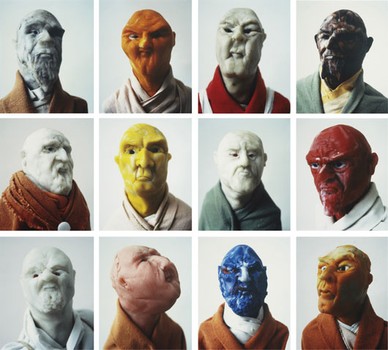
Gerhard Richter, twisted clay faces, a sacrilegious frog, and reinterpretation coming soon to LA!


Good news all you Angelenos! Gerhard Richter is coming to town. Nicolas Berggruen, son of the famous art collector Heinz Berggruen has scrapped his plans to build a museum in Berlin and is in stead sending a number famous well known German paintings to Los Angeles on long term loans instead. He will be sending works by influential German artists like Thomas Schütte, Martin Kippenberger, Gerhard Richter and Joseph Beuys to help Los Angeles, whom he says, "is still a developing culture center". Other than that ego crushing dig, LA should be happy to receive some of these guys work.

We know about Gerhard, a star of the Leibnizian Ramblings blog because of his prolific work with the blur, but what over these other guys?

Schütte actually trained with our pal Gerhard at Kunstakademie Düsseldorf and is mainly a sculptor. He, like Gerhard, is a living German artist that continues to shape the contemporary art world. His sculptures often resemble the claymation of that Tool video "Sober".

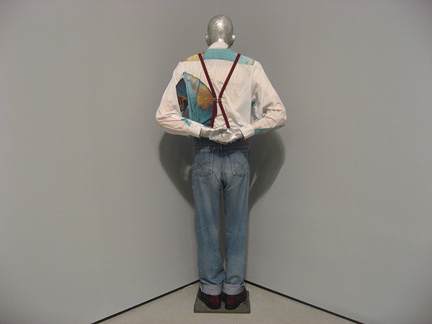
Kippenberger put out massive amount of work before his early death in 1997. He never adopted a single style, or even a medium and that helped him to put out as much work as he did in his short 44 years. When he wasn't being an absolutely sacrilegious nightmare (he put a frog on a cross and called it "Fred the frog rings the bell"), he used his sarcasm and wit better than most artists. My favorite came from 1989, after he was accused of being a neo-Nazi sympathizer by a German critic named Wolfgang Faust (that is an incredibly German name by the way, well played by patriotic parents) Kippenberger made a statue of himself and placed it facing its nose in a corner. The statue's name is "Martin, into the corner, you should be ashamed of yourself". Oh the sarcasm tastes delightful.

Last on our list from Berggruen's blessings is Joseph Beuys. Beuys was a little bit older than the other three and while he played around with performance art, our favorite part about Beuys was his ideas. In addition to being an artist, he was an art theorist that had a penchant for the dramatic. As part of his mystique as an artist he often would (and this is a friendly way of putting it) reinterpret his own history to better fit the art he was in the process of. The best reinterpretation comes from his time in the Luftwaffe in WWII. He was shot down in Crimea and according to eyewitnesses was rescued by a German commando shortly after the plane crashed. When Beuys tells the story he is found four days after the crash by nomadic Tartars who took him into their tents, wrapped him in animal fat and saved his life. Reinterpretation in the most delicious of ways.

So Angelenos you must get over to Los Angeles County Museum of Art and thank Nicolas Berggruen for his wonderful endowment.

Thursday, December 29, 2011

Gerhard Richter, the man


The Leibnizian Ramblings has focused a lot of attention on Gerhard Richter since the birth of this blog. I think it is high time that we now really get to know the man.

So who is Gerhard Richter? Born in my old stomping grounds of Saxony in 1932 he spent his early days in and around Dresden. He studied under Karl von Appen and others before escaping East Germany. When he escaped a few of his paintings were painted over for political reasons. Since following the manifest destiny and traveling west he began to paint an anti-art style known as Capitalistic Realism. Through this period he used art to show the over indulgent consumerism in Western art. But, he has ventured out of this into many different styles, including but not limited to more abstract and minimalist works. He even designed a stained glass window that adorns the Cologne Cathedral. Unfortunately though the window was not to the liking of Joachim Meisner who said the window would more properly fit a mosque motif, rather than a Christian church.

But why has Richter come to prominence in this blog? First, many consider him to be among the, if not the greatest living artist. It is not place to judge these things as I seek only to be informed and do my best to inform. However, I would be remiss in my quest for knowing what is worth knowing if I ignored so prominent a figure as Gerhard Richter. But, in all reality, Gerhard Richter was the first artist from my old homeland of Saxony to catch my eye. It is only a bonus that he happens to be someone of world note. So as we move forward on our crabwise journey towards utter enlightenment in the non-moksha sense Richter will be a benchmark that we measure all art against. Much like we shall judge all movies against Ken Finkleman's cinematic classic Airplane II: The Sequel.

Remember folks, "Irony can be pretty ironic sometimes"

Wednesday, December 28, 2011

In times of financial stress we turn to the stabilizing force that is Gerhard Richter


2011 was admittedly a pretty volatile year for investing. It was up and down and up and down to the point that I felt a little bit sick watching my modest investments plummet and recover. But, the überinvestors, the Übermensch of the financial world, while no sympathy is necessary, were all over the place. If I lost 20% and then gained it back we are talking about $20 daily swings. For them, we're adding six zeros. On a daily basis! Again, I'm not advocating sympathy for these guys, just admitting my astonishment at that number.

All this market volatility has made speculators move from stocks and bonds into art and wine. I'll never understand collecting wine. Wine in my view is better or worse only when one tastes it. It's financial value is in some ways detrimental to its intrinsic value. Purchasing wine for collection purposes also has no instrumental purpose as it does not enhance the intrinsic value. If that $1,000 dollars worth of wine, say, a case of 1978 Léoville Las Cases sits only in a cellar and is never enjoyed for its intended purpose its intrinsic value is lost entirely. The buying and selling of wine for collection purposes only therefore destroys its intrinsic value and creates a purely artificial one. Artificial value is utterly meaningless, rendering wine pointless. But, I have digressed.

Art purchasing is something I understand a bit more. Fine art and fine art collectors have been around for nearly as long as each other. Generally speaking art investment is a good idea. In these financially tumultuous times, wealthy investors have turned to art as a safe haven. The contemporary art market has surged to a $1.7 Billion dollar industry this year, up 35%. Who tops this list? None other than our good friend Gerhard Richter. Richter set records at both Sotheby's and Christie's this year. Fair play Gerhard.

Saturday, December 24, 2011

Gerhard Richter is back!

On a more positive note, Gerhard Richter was back in the news today over at the Financial Times. Tally one for art

Capitalism 2 - Art 1

Thursday, December 22, 2011

A lack of Gerhard Richter News


There was no Gerhard Richter news today. :(

On a side note, I rubbed my eyes a little bit too hard today and suffered from blurred vision for 13.8 seconds.

Wednesday, December 21, 2011

Crumbled blueberry scone and Libidinous Goans

Saxony Line I-II

In my research today I learned that nullification is a form of body modification where one voluntarily removes a body part. I simply have no optimistic estimation of this. Therefore, nullification is simply out as a topic to continue this glorious Saxony Line. I also wonder what Gerhard Richter is doing, trying to nullify everyone with his blurs.

Gerhard Richter was in the news today. He, or rather the dangerous nullifying blurs that he is known for, are on display at the Tate Modern until the 8th of January. All my friends in the UK that have a penchant for daredevilry should go and scope this out. So long as I keep all of my limbs in tact, I must admit that I do enjoy a good destabilizing force in modernist fashion coupled with post-modern ruination. It goes excellent with a shot of brandy sunken into an espresso with a blueberry scone. For the full effect pour the brandied espresso on the sauce and crumble the scone into the mug. Perfect ruination.

All this talk of scones and espresso has rather perked up my appetite. Apologies for that sidetrack. Onward the glorious Saxony Line of thought!

The thing that I wanted most to discuss today was this show at the Vadehra Art Gallery in New Delhi called Picasso-Souza. There is a mess of cubism and pre-cubism and post-cubism doodling hanging on the walls by two artists, one well known (Pablo Picasso: Fumear a la cigarette rouge) and one not so well known (Francis Newton Souza: untitled, head of picasso). Fair play to the Hindustan Times on giving me the heads up on this one. It was a lot easier to read things about Earth in Heaven because of the whole time difference.

Obviously Picasso is a master and I like cubism, maybe not as much as its offshoots sprinkled with a little bit of Surrealism, but I like it. I even checked up on this guy Francis Newton Souza. He's from Goa, India and was a leader in the Progressive Artists' Group of Bombay. I checked out some of their work too. Good stuff. Anyway, this isn't really a critique, I don't feel I've got the chops to critique Picasso. Especially since he knows where I live upstairs.

I will say this though, Conor Macklin , comparing the two said, "The two had a lot in common." He then summarized what they had in common: being "competitive" and "iconic". I get that. Neither forgot their roots, Spain for Picasso and India for Souza. Good so far. Both led artistic revolutions, one in Europe and the other in India. Spot on. But then he says, "they were both criticized - Picasso for his anti-war works, and Souza for his erotic ones." What?

I don't know the back story of Souza enough to know why he painted erotic paintings. Maybe it was only to paint erotic paintings, but sometimes art has a deeper meaning. The Saxony Line of thinking marches on towards a different path than researching the deeper, more secret meaning to Souza's concupiscent caricatures. (If you know it post it here on a comment please). But at first blush the director of Grosvenor Vadhera Gallery in London equates a pacifism stance with a horny one. Read it in the headlines. It's all there. None of this is made up. Enjoy the art!

Monday, December 19, 2011

Leipzig Football and Blurry Art

Saxony Line I-I

I was traipsing around my old home in Leipzig this afternoon looking for something to get me started when I stumbled upon the football scene. I was dismayed to find the FC Lokomotive Leipzig, or VfB Leipzig if you will, plays in the 5th tier of the German football league system. We are far removed from our 7-2 thrashing of DFC Prag to claim the Viktoria Meisterschaftstrophaee!!! But, nonetheless here is FC Lokomotive now.

But, I am not here to talk football. That will come in due time. I was looking for a starting point for my Saxony line of thinking. Traipsing around and galavanting through the streets of Leipzig proved fruitless and attracted too much attention with my incredible flowing locks so I took to a more quiet and reserved place and checked on the news at a local pub. I listened for awhile as men and women gabbed over things when I happened upon a conversation that caught my attention.

I overheard a few men discussing whether or not Dresden's own Gerhard Richter was truly the world's greatest artist. I enjoy art so I took a look at some of Richter's work. I began to question my eyesight because of his "blur" technique. How was I supposed to know that his blurring was intentional. I said to myself, "self, you must get some glasses because this beautiful artwork is blurry". Apparently though, I had not said this to myself because a feisty little tween, who ironically looked like an unblurred version of the painting, informed me that it was intentional. "The blur", she said "was done in order to nullify the subject in order to make it difficult to understand. The painting of the photograph intensifies the plastic nature of painting". With that she walked away.

I was left feeling a little bit nullified myself. I began to feel a bit grumpy at the pretentiousness of the little girl and my complete and utter lack of understanding of this art. But, then I began to become a bit more cheery as I thought to myself, now I have two more subjects to look into, art and nullification. Ah, the study of beauty is such a rich and enjoyable subject when one has the leisure to perceive it!