Showing posts with label Art. Show all posts

Thursday, January 26, 2012

1300 years of Bulgaria in Шумен, Šumen, or Shumen


Шумен, Šumen or otherwise known as Shumen is the tenth largest city in Bulgaria. We only mention this because we are in the habit of rehashing old posts, we mean clarifying things we said in older posts. All of our posts are credible and new material and we would never pander to our most popular posts to drive revenues, we mean readership. But alas, we mentioned the statue of 1300 years of Bulgaria and its cubism structure in a post about a little known American-German artist named Lyonel Feininger.

We mentioned the statue because it is what we think of ourselves. But, in reality it is a long tradition of Bulgarian art, see from the Icon of St. Theodor there in the picture that cubism has existed for much longer than we thought in Bulgaria. Never mind that the depreciation of the work of art is largely responsible for the squarish patterns on the parchment. We shall give credit to Bulgaria to being a precursor to cubism.

The monument was built in 1981 to commemorate the 1300 years of time passage since the formation of the first Bulgarian Empire. This empire was founded when the Bulgars, a Turkic and Scythian people group teamed up with seven South Slavic tribes. They became a force to reckon with and crushed their way into Pannonia, battle against the Arabs in defense of Constantinople and then had their own successes against the power of the city of Constantine. At the height of their power they possessed lands in Balkans and into northern Greece, parts of modern day Turkey and northern lands into Hungary and of course, Bulgaria.

The Golden age was during the reign of Simeon the Great (893 - 927 A.D.). Simeon went to war with and defeated powerful groups like the Serbs, the Magyars and the might of Constantinople. While the Christianization of Bulgaria had taken place earlier, under Simeon many Christian works were copied into Slavic languages, paving the way for the Christianization of Eastern Europe. Simeon the Great has been compared to Charlemagne, the French Historian Alfred Nicolas Rambaud wrote, "Simeon was the Bulgarian Charlemagne, but he was better educated than our Charles the Great and much greater than him".

Sadly after Simeon passed away the power of Bulgaria waned and a resurgent and rather put out Constantinople pushed back. The complete fall of the First Empire of Bulgaria occurred when the Byzantine Empire defeated the Bulgarians at the Battle of Kleidion in 1014. Basil II or Basil Bulgaroktonos (Bulgar killer in Greek) line the Bulgarian army in rows of 100. He killed 99 of the Bulgarians and blinded the eye of the remaining 1. Upon seeing the decimation of his army, the last ruler of the first Empire of Bulgaria, Samuil had a heart attack and died.

So, why was the statue placed in the city Shumen? Shumen was the capital of Simeon the Great's Bulgaria. It was eventually taken by the Ottoman Turks and was a minor city for nearly 400 years. Then the Russians tried to wrest it from the hands of the Ottomans three times, all unsuccessfully. Then in the early 19th century Shumen became a place for Bulgarian nationalistic tendencies. At the end of the 19th century Shumen fell to Russia and became a part of the Principality of Bulgaria, which would become the Kingdom of Bulgaria, which would become the People's Republic of Bulgaria, and then finally, the modern Republic of Bulgaria.

The Monument of 1300 Years of Bulgaria is a huge artistic achievement. It is also the only statue to tell the entire history of a nation from its founding to the present day. Obviously, Mount Rushmore is entirely lacking when put into context.

Wednesday, January 25, 2012

Gerhard Richter continues to make Sothebys wealthy


Gerhard Richter, our favorite painter from Dresden continues to make the auction house Sotheby's rich beyond the dreams of Solomon. Richter sold two paintings this year in route to a boon for Sotheby's $1.17 Billion dollar sales in Contemporary Art. His "Eis" (ICE) will sell for £2–3 million. His "Abstraktes Bild 'Rot'" will sell for £2.5–3.5 million respectively. We here at Leibnizian Ramblings would settle for a print. Please donate to our optimism cause so that we can purchase a Gerhard Richter piece, forgery or otherwise. If you don't optimism will die and you will live forever in the pessimism that cripples the very soul...

We all need a bit of Cubism in our well-rounded lives


Hanover Line I-XXI

Last time we sold out on the Leibnizian Ramblings blog. We drew some pictures for the few people that decided to repost our blog posts. We'd like to thank the kind gentlemen that may or may not be our doppelgänger, otherwise known as our other email account. The stick figure cubism rendition of the famous Katz scene in When Harry Met Sally is on the way.

We however got on a topic that is near and dear to our hearts, Cubism. We think that we enjoy cubism so much because our residual mental image of ourselves is closely akin to Simeon the Great in the Statue known as the Monument to 1300 Years of Bulgaria. It is for this reason that we do not own any mirrors. But nonetheless, we are cubists at heart.

We all know the well-known Cubists or Cubists inspired artists (artists are generally even more opposed to labels than hipsters - in fact, it could be argued that Marcel Duchamp may actually have been a hipster). They include the incredible Pablo Picasso, Mexican artist Diego Rivera and Max Weber. Today however, we'd like to focus on the little known, but highly influential Lyonel Feininger.

Feininger was born in America but lived much of his life in Germany. Prior to WWII he studied in Germany and began to create important pieces of art. When the Nazi Party came to power his work was labeled Entartete Kunst (degenerate art). He came back home to New York and continued his work. Feininger passed into obscurity, at least in North America, because of his time in Germany. He passed away in 1956 and since then his work has not been displayed in its full breadth until now.

The Montreal Museum of Fine Arts is presenting a pretentious sounding "first posthumous retrospective in North America". We get it, art, like hipster has to sound grandiose. But let's break it down for the majority of us who want to experience art as a way of living a well rounded life and not the vocal minority that hopes to use art as a way of making others feel stupid. We here at the Leibnizian Ramblings would never condone such an act...

What is really interesting about this collection is that the full breadth of his work is being put on display. Feininger was more than just a painter. He was a cartoonist first. Then he did a lot of paintings. Then he did some sketching and engraving. Then he started to make engraved toys. He also tinkered with photography. The toys and the photography were never displayed in his lifetime, so seeing all of his work in one place will be a neat thing. Make the trek up to Montreal. Take in Feininger's art, a Canadiens game and eat some poutine. It'll be worth the go...

Oh by the way Feininger was an accomplished violinist and composer to boot.

Wednesday, January 18, 2012

Gerhard Richter is coming to Israel!!!


Gerhard Richter's painting Abstraktes Bild 849-3, completed in 1997 was sold at Sotheby's in November of 2011 for $20.8 million dollars. It was originally thought that the French Billionaire Bernard Arnault had bought the painting for the $200 million dollar museum he's planning on building in Paris. Apparently though, it was not and the Richter is heading to Israel and not to France.

Lily Safra, the widow of the banker Edmond J. Safra bought it and promptly donated it to the Israel Museum. Safra is no stranger to splashing out or as the kids say it, making it rain over art. In 2010, she bought Alberto Giacometti's bronze statue Walking Man I for a reported $104.3 million dollars.

In unrelated news we have just purchased a canvas, some oil paint, a squeegee and a spam email account aimed at Lily Safra and her incredibly deep purse. We shall be working on our work for the next forty-two minutes and then sending the spam mail featuring pictures of it to her in clandestine ways. Wish us luck!!

Friday, January 13, 2012

Denmark takes over the European Union, green turns blue


Saxony Line I-XV

Last time as we were tromping around the hallowed halls of this mental construct loosely based upon the Chemnitz, Dresden and Leipzig union we call Saxony we discussed pancakes, and the danger of eating them. This post was the most viewed of all my one hundred and eleventieth posts. Thanks for that! In it we discussed the Danish West Indies so we'd thought we'd have a look at them Danes today.

Denmark took over as the President of the European Union yesterday and it faces a great number of challenges in the year ahead. There is question over the survival of the Euro. There are Euro skeptics about making noise, especially in Britain and France with Marine Le Pen and National Front. There is tension between the 17 euro zone members and the 10 others who are part of the European Union but don't use the euro. In the midst of all this the Danes took center stage and set forth their green agenda. The timing was a bit awkward though because on the day that Denmark took over the European Union, ushering in a green agenda, Vestas, the world's largest producer of wind energy announced that they were cutting 2,335 jobs. That makes the green very blue.

To be fair, Vestas is just another victim of the European sovereign debt crisis and there is nothing wrong with the model per se. Companies simply are being crushed by their governments' debts. Note to America... However, it ought to be a good year for the Danes in charge of the European Union. They are a northern country that tends to be better with their money than those pesky southerners. Hopefully we will see a bit of Copenhagen in places like Athens, Oporto, Madrid, Rome and further south. If this were to happen what could we expect?

Could we see Athenians trading their gyros and moussaka for a hearty Smørrebrød? Somehow though I don't see too many Greeks giving up their buttery and flakey deliciousness for a hunk of dense rye bread topped with salmon and roe.

Could we see the Casa da Música host Chris Minh Doky and his jazz stylings to see the sluggish Portuguese economy revive? Why not? The Casa da Música is one of Portugal's premier venues and an icon of the city that has Northern European touches already (it was designed by a Dutch architect).

Could we see Danish design and architecture take hold in the streets, buildings and hearts of madrileños? Would a row or two of Arne Jacobsen's Swan Chairs be inappropriate at the Temple of Debod? Would some Danish Functionalism blend well with the baroque the façade of Basílica of San Miguel? We'll say that Swan Chairs are appropriate in any location, including relocated Ancient Egyptian ruins in Spain, but that the minimalism of Functionalism would cause serious harm to Madrid's historical vistas.

Could we see a Renaissance of Gabriel Axel in Lazio, rolling down the peaks of the Tolfa Mountains and pouring out into the Maremma Laziale before entering the gates of Rome to receive his long due triumph? His movie Babbete's Feast could play out and a simple act of kindness repaid could cause a mystical reawakening of glorious proportions. We are unfortunately though realizing that if the Gabriel Axel Renaissance takes place in the land of Silvio Berlusconi it shan't be Babbete's Feast that leads the way but Gabriel Axel's manifesto to legalize pornography Det kære legetøj. We can already see the bunga bunga headlines.

Or could we even see a return of the Vikings just in time to crush the Somali pirates who look to choke the life out of the trading industry in the Indian Ocean? The Somalis would never be a match for Ragnar Lodbrok and his longships. The once reviled scourge of Rouen and Paris could atone for his heathen conquest of France and extract more than 7000 pounds of silver from the Somalis. Unleash thy fury and thy sons Ragnar - especially Ivar the Boneless. That man is terrifying. York still quakes in fear.

Thursday, January 12, 2012

Gerhard Richter, a carbon footprint analysis


After a few days out of the spotlight, but never out of our hearts and minds, Gerhard Richter has once again come to the headlines. However, this time it is not what he has done, but what he has inspired that has brought him the fame and glory that he so worthily deserves. Michael Wang, an artist and architect has developed 20 works of art to offset the carbon footprint left by 20 famous pieces of art throughout history. He's made one to offset Richard Serra's torqued ellipse, if you've ever been to the MoMA its the huge winding sheets. He's made one to offset the enormous installation piece by Anish Kapoor entitled Taratantara. Michael Wang has even done a piece to offset Gerhard Richter's 4900 Colours Version II. Michael Wang's 20 pieces are entitled "Carbon Copies" and are on display at Foxy Productions in New York. Now that we have these pieces by Michael we can continue to enjoy our Gerhard Richter without feeling so environmentally depressed by all of the footprints that art is leaving on the world.

Friday, January 6, 2012

Gerhard Richter, twisted clay faces, a sacrilegious frog, and reinterpretation coming soon to LA!


Good news all you Angelenos! Gerhard Richter is coming to town. Nicolas Berggruen, son of the famous art collector Heinz Berggruen has scrapped his plans to build a museum in Berlin and is in stead sending a number famous well known German paintings to Los Angeles on long term loans instead. He will be sending works by influential German artists like Thomas Schütte, Martin Kippenberger, Gerhard Richter and Joseph Beuys to help Los Angeles, whom he says, "is still a developing culture center". Other than that ego crushing dig, LA should be happy to receive some of these guys work.

We know about Gerhard, a star of the Leibnizian Ramblings blog because of his prolific work with the blur, but what over these other guys?

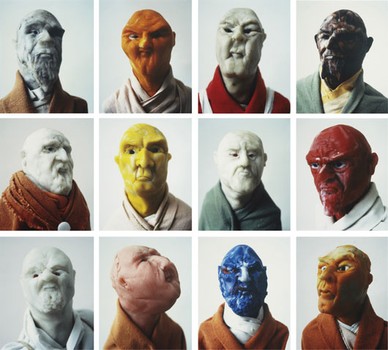
Schütte actually trained with our pal Gerhard at Kunstakademie Düsseldorf and is mainly a sculptor. He, like Gerhard, is a living German artist that continues to shape the contemporary art world. His sculptures often resemble the claymation of that Tool video "Sober".

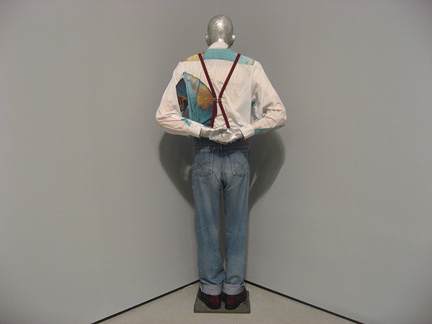
Kippenberger put out massive amount of work before his early death in 1997. He never adopted a single style, or even a medium and that helped him to put out as much work as he did in his short 44 years. When he wasn't being an absolutely sacrilegious nightmare (he put a frog on a cross and called it "Fred the frog rings the bell"), he used his sarcasm and wit better than most artists. My favorite came from 1989, after he was accused of being a neo-Nazi sympathizer by a German critic named Wolfgang Faust (that is an incredibly German name by the way, well played by patriotic parents) Kippenberger made a statue of himself and placed it facing its nose in a corner. The statue's name is "Martin, into the corner, you should be ashamed of yourself". Oh the sarcasm tastes delightful.

Last on our list from Berggruen's blessings is Joseph Beuys. Beuys was a little bit older than the other three and while he played around with performance art, our favorite part about Beuys was his ideas. In addition to being an artist, he was an art theorist that had a penchant for the dramatic. As part of his mystique as an artist he often would (and this is a friendly way of putting it) reinterpret his own history to better fit the art he was in the process of. The best reinterpretation comes from his time in the Luftwaffe in WWII. He was shot down in Crimea and according to eyewitnesses was rescued by a German commando shortly after the plane crashed. When Beuys tells the story he is found four days after the crash by nomadic Tartars who took him into their tents, wrapped him in animal fat and saved his life. Reinterpretation in the most delicious of ways.

So Angelenos you must get over to Los Angeles County Museum of Art and thank Nicolas Berggruen for his wonderful endowment.

Thursday, December 29, 2011

Gerhard Richter, the man


The Leibnizian Ramblings has focused a lot of attention on Gerhard Richter since the birth of this blog. I think it is high time that we now really get to know the man.

So who is Gerhard Richter? Born in my old stomping grounds of Saxony in 1932 he spent his early days in and around Dresden. He studied under Karl von Appen and others before escaping East Germany. When he escaped a few of his paintings were painted over for political reasons. Since following the manifest destiny and traveling west he began to paint an anti-art style known as Capitalistic Realism. Through this period he used art to show the over indulgent consumerism in Western art. But, he has ventured out of this into many different styles, including but not limited to more abstract and minimalist works. He even designed a stained glass window that adorns the Cologne Cathedral. Unfortunately though the window was not to the liking of Joachim Meisner who said the window would more properly fit a mosque motif, rather than a Christian church.

But why has Richter come to prominence in this blog? First, many consider him to be among the, if not the greatest living artist. It is not place to judge these things as I seek only to be informed and do my best to inform. However, I would be remiss in my quest for knowing what is worth knowing if I ignored so prominent a figure as Gerhard Richter. But, in all reality, Gerhard Richter was the first artist from my old homeland of Saxony to catch my eye. It is only a bonus that he happens to be someone of world note. So as we move forward on our crabwise journey towards utter enlightenment in the non-moksha sense Richter will be a benchmark that we measure all art against. Much like we shall judge all movies against Ken Finkleman's cinematic classic Airplane II: The Sequel.

Remember folks, "Irony can be pretty ironic sometimes"

Wednesday, December 28, 2011

In times of financial stress we turn to the stabilizing force that is Gerhard Richter


2011 was admittedly a pretty volatile year for investing. It was up and down and up and down to the point that I felt a little bit sick watching my modest investments plummet and recover. But, the überinvestors, the Übermensch of the financial world, while no sympathy is necessary, were all over the place. If I lost 20% and then gained it back we are talking about $20 daily swings. For them, we're adding six zeros. On a daily basis! Again, I'm not advocating sympathy for these guys, just admitting my astonishment at that number.

All this market volatility has made speculators move from stocks and bonds into art and wine. I'll never understand collecting wine. Wine in my view is better or worse only when one tastes it. It's financial value is in some ways detrimental to its intrinsic value. Purchasing wine for collection purposes also has no instrumental purpose as it does not enhance the intrinsic value. If that $1,000 dollars worth of wine, say, a case of 1978 Léoville Las Cases sits only in a cellar and is never enjoyed for its intended purpose its intrinsic value is lost entirely. The buying and selling of wine for collection purposes only therefore destroys its intrinsic value and creates a purely artificial one. Artificial value is utterly meaningless, rendering wine pointless. But, I have digressed.

Art purchasing is something I understand a bit more. Fine art and fine art collectors have been around for nearly as long as each other. Generally speaking art investment is a good idea. In these financially tumultuous times, wealthy investors have turned to art as a safe haven. The contemporary art market has surged to a $1.7 Billion dollar industry this year, up 35%. Who tops this list? None other than our good friend Gerhard Richter. Richter set records at both Sotheby's and Christie's this year. Fair play Gerhard.

Saturday, December 24, 2011

Gender Bending Photomontages and a redefining of art


Saxony line I-IV

The last time we wrote on overstockart.com's top ten oil paintings of 2011 featuring paintings no more recent than 79 years. It made me pause for a second. I thought maybe oil paintings stopped being made well. But, as any good thinker does, I went to the source. Upon further investigation I believe that the top ten paintings of 2011 won their award due to the layout and marketing of the website and not because of any intrinsic value within the paintings. Score one for Capitalism, zero for art. But, I did like some of the paintings from artists that I had not ever noticed before.

One of them was a lady by the name of Hannah Höch from my western neighbor of Gotha, Thuringia. She was a German Dada artist who had a penchant bucking against conventions and traditional roles of men and women. Which could explain the hairy arms of a female mannequin or the winking male mask upon slender female legs in those pictures above. Or she could have been like most dada artists and have simply been strange.

Of course, whenever one thinks of Dada art, which is surprisingly often, they instantly think of Marcel Duchamp's seminal piece Fountaine. The thought provoking nature of a urinal has forever shaped the way we view art. The dethroning of the artist as a god and shifting art estimation from valuing the creative process' work to the more sophisticated mind's interpretative prowess has allowed us to have a definition of art so vast that everything can be considered art. (Thankfully for this blog, my labor no longer constitutes the merit of the work. It simply exists as art, next to literary genius like Plato's Republic, Tolstoy's War and Peace, Proust's In Search of Lost Time and Meyer's New Moon).

On a completely unrelated note I recently hung a reproduction of the Mona Lisa at a 14 degree tilt in a frame that I bought from the local hardware store, took a polaroid of it and signed my name on the white bottom part and submitted it to the local art show. The piece is entitled "Abs? Ur De Leibniz" Last night was the opening of the show and my picture was nowhere to be found. I plan on writing a rather scathing oped piece for the New York Times denouncing the bourgeois establishment that this plastic art community now operates under through their neo-expressionist, novocolonial oppressive mechanistic mindset. On the upside however the piece can be found on eBay for the low bargain of $4.95 and rising (plus $19.95 s&h).

Score two for capitalism, zero for art.

Thursday, December 22, 2011

Top 10 Oil Paintings of 2011


Saxony Line I-III

Continuing the glorious Saxony Line of Thought...

Thanks to these guys I now know the ten most popular oil paintings of 2011.

1. Starry Night - Vincent Van Gogh (1889)
2. Café Terrace at Night - Van Gogh (1888)
3. Branches of an almond tree in blossom - Van Gogh (1888)
4. The Kiss - Gustav Klimt (1908)
5. Garden path at Giverny - Claude Monet (1902)
6. Poppy field at Argenteuil - Monet (1875)
7. The Dream - Pablo Picasso (1932)
8. Farbstudie Quadrate - Wassily Kandinsky (1913)
9. Persistence of Memory - Salvador Dali (1931)
10. The Old Guitarist - Pablo Picasso (1903)

It is my conclusion from the dates of the paintings that all art stopped prior to World War II, or at least there hasn't been any good art produced since then. Join me next time when we discuss the nature of popularity. Adieu.

Wednesday, December 21, 2011

Crumbled blueberry scone and Libidinous Goans

Saxony Line I-II

In my research today I learned that nullification is a form of body modification where one voluntarily removes a body part. I simply have no optimistic estimation of this. Therefore, nullification is simply out as a topic to continue this glorious Saxony Line. I also wonder what Gerhard Richter is doing, trying to nullify everyone with his blurs.

Gerhard Richter was in the news today. He, or rather the dangerous nullifying blurs that he is known for, are on display at the Tate Modern until the 8th of January. All my friends in the UK that have a penchant for daredevilry should go and scope this out. So long as I keep all of my limbs in tact, I must admit that I do enjoy a good destabilizing force in modernist fashion coupled with post-modern ruination. It goes excellent with a shot of brandy sunken into an espresso with a blueberry scone. For the full effect pour the brandied espresso on the sauce and crumble the scone into the mug. Perfect ruination.

All this talk of scones and espresso has rather perked up my appetite. Apologies for that sidetrack. Onward the glorious Saxony Line of thought!

The thing that I wanted most to discuss today was this show at the Vadehra Art Gallery in New Delhi called Picasso-Souza. There is a mess of cubism and pre-cubism and post-cubism doodling hanging on the walls by two artists, one well known (Pablo Picasso: Fumear a la cigarette rouge) and one not so well known (Francis Newton Souza: untitled, head of picasso). Fair play to the Hindustan Times on giving me the heads up on this one. It was a lot easier to read things about Earth in Heaven because of the whole time difference.

Obviously Picasso is a master and I like cubism, maybe not as much as its offshoots sprinkled with a little bit of Surrealism, but I like it. I even checked up on this guy Francis Newton Souza. He's from Goa, India and was a leader in the Progressive Artists' Group of Bombay. I checked out some of their work too. Good stuff. Anyway, this isn't really a critique, I don't feel I've got the chops to critique Picasso. Especially since he knows where I live upstairs.

I will say this though, Conor Macklin , comparing the two said, "The two had a lot in common." He then summarized what they had in common: being "competitive" and "iconic". I get that. Neither forgot their roots, Spain for Picasso and India for Souza. Good so far. Both led artistic revolutions, one in Europe and the other in India. Spot on. But then he says, "they were both criticized - Picasso for his anti-war works, and Souza for his erotic ones." What?

I don't know the back story of Souza enough to know why he painted erotic paintings. Maybe it was only to paint erotic paintings, but sometimes art has a deeper meaning. The Saxony Line of thinking marches on towards a different path than researching the deeper, more secret meaning to Souza's concupiscent caricatures. (If you know it post it here on a comment please). But at first blush the director of Grosvenor Vadhera Gallery in London equates a pacifism stance with a horny one. Read it in the headlines. It's all there. None of this is made up. Enjoy the art!

Monday, December 19, 2011

Leipzig Football and Blurry Art

Saxony Line I-I

I was traipsing around my old home in Leipzig this afternoon looking for something to get me started when I stumbled upon the football scene. I was dismayed to find the FC Lokomotive Leipzig, or VfB Leipzig if you will, plays in the 5th tier of the German football league system. We are far removed from our 7-2 thrashing of DFC Prag to claim the Viktoria Meisterschaftstrophaee!!! But, nonetheless here is FC Lokomotive now.

But, I am not here to talk football. That will come in due time. I was looking for a starting point for my Saxony line of thinking. Traipsing around and galavanting through the streets of Leipzig proved fruitless and attracted too much attention with my incredible flowing locks so I took to a more quiet and reserved place and checked on the news at a local pub. I listened for awhile as men and women gabbed over things when I happened upon a conversation that caught my attention.

I overheard a few men discussing whether or not Dresden's own Gerhard Richter was truly the world's greatest artist. I enjoy art so I took a look at some of Richter's work. I began to question my eyesight because of his "blur" technique. How was I supposed to know that his blurring was intentional. I said to myself, "self, you must get some glasses because this beautiful artwork is blurry". Apparently though, I had not said this to myself because a feisty little tween, who ironically looked like an unblurred version of the painting, informed me that it was intentional. "The blur", she said "was done in order to nullify the subject in order to make it difficult to understand. The painting of the photograph intensifies the plastic nature of painting". With that she walked away.

I was left feeling a little bit nullified myself. I began to feel a bit grumpy at the pretentiousness of the little girl and my complete and utter lack of understanding of this art. But, then I began to become a bit more cheery as I thought to myself, now I have two more subjects to look into, art and nullification. Ah, the study of beauty is such a rich and enjoyable subject when one has the leisure to perceive it!